

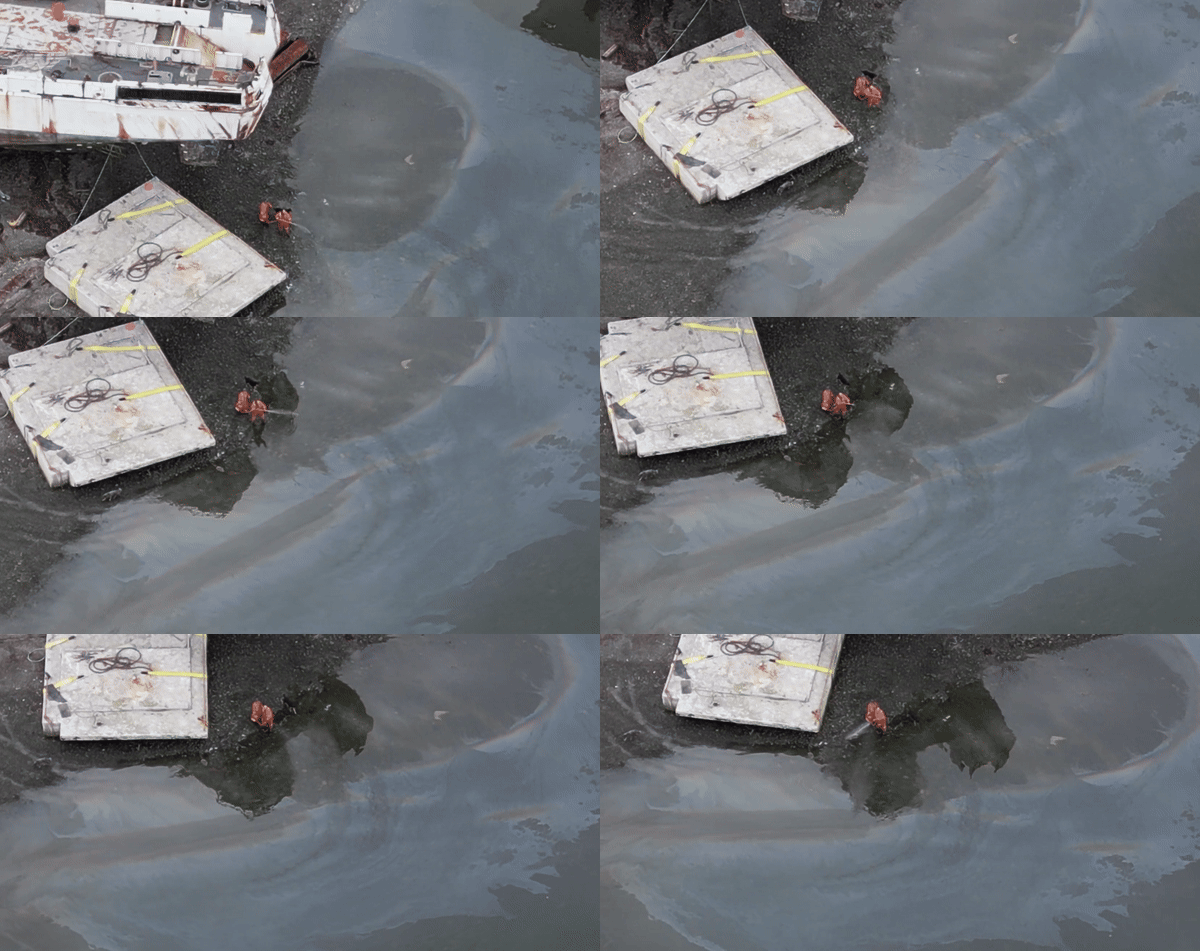
Organizers and stakeholders gathered to discuss shipbreaking and the future of stewardship for Baynes Sound.
BY MADELINE DUNNETT, LOCAL JOURNALISM INITIATIVE REPORTER ● COMOX VALLEY ● NOVEMBER 21, 2024
Editor’s note: Madeline Dunnett, the author of this story, presented at the 2024 Baynes Sound/Lambert Channel Ecological Forum and provided an overview of past reportingdone on shipbreaking.
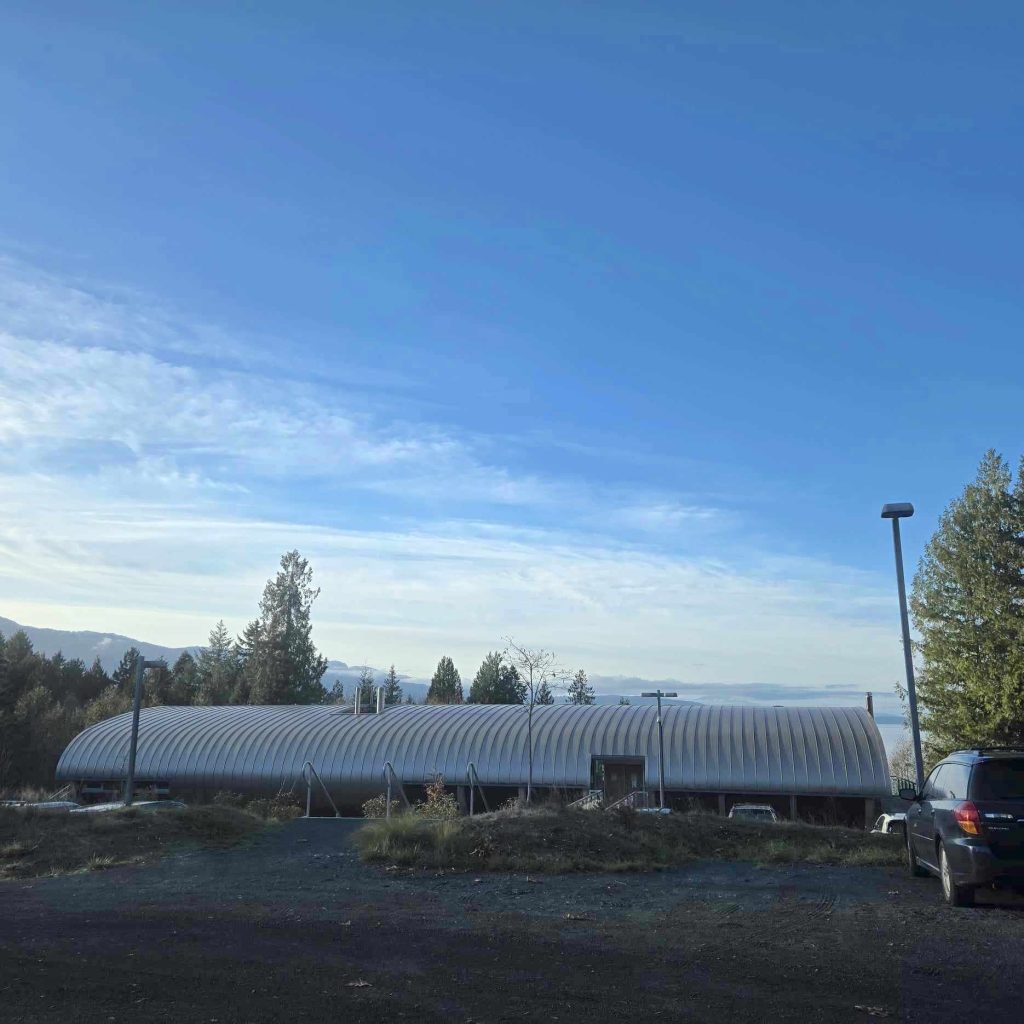
Community members and organizations gathered on Friday, Nov. 15 for the semi-annual Baynes Sound/Lambert Channel Ecological forum.
The forum, which has been meeting since 2017, brings local organizations and community members together to discuss topics related to the well-being of the marine ecosystem in Baynes Sound and Lambert Channel.
This year’s theme was focused on shipbreaking in Baynes Sound that is being conducted by Deep Water Recovery, a company that has been dismantling vessels in Baynes Sound since late 2020. The company’s operation has left a trail of court cases, a pollution abatement order and loud opposition from the community in its wake.
The forum included a variety of voices, though most groups called for an end to shipbreaking in this location due to the ecological and cultural significance of the area and its proximity to residences.
Dozens of people from different community groups attended the discussion, but forum organizers confirmed later with The Discourse that they decided not to invite Deep Water Recovery, stating the forum wanted to instead focus on how jurisdictional gaps were impacting the marine ecosystem more widely.
Most groups want to see an end to shipbreaking in Baynes Sound
The Discourse reporter Madeline Dunnett presented at the start of the forum, providing a summary of The Discourse’s past coverage on the topic of shipbreaking and what she has learned so far. Others in attendance included Marilynne Manning from grassroots group Concerned Citizens of Baynes Sound (CCOBS), CCOBS lawyer Carla Conkin and Nicola Mulinaris from NGO Shipbreaking Platform. Many of these individuals have shared their opposition to Deep Water Recovery’s operation in past reporting from The Discourse.
Representatives from K’ómoks First Nation and Tla’amin Nation were also in attendance, stating their opposition to the project.
Candace Newman, elected K’ómoks Councillor and former K’ómoks Guardian, said she is concerned to see so much of her Nation’s harvesting area lost over the years due to the impacts of industrial operations.
“We feel a lot of pressure from all of the industries. Today, we’re just talking about Deep Water Recovery and its impacts on our rights, but it’s hard to separate that from everything else that is happening here in the Comox Valley and on the coast of B.C.”
Union Bay is on the unceded territory of the K’ómoks First Nation, and Newman added that if K’ómoks ratifies its treaty — which the Nation is voting on in March 2025 — Baynes Sound will be designated as an area of cultural and spiritual significance.
NDP Member of Parliament for Courtenay-Alberni Gord Johns also spoke at the event, and Josie Osborne, NDP MLA for Mid Island-Pacific Rim, was present in the audience.
Johns has been public about his opposition to Deep Water Recovery in the past, and he said he will bring the issues and concerns he heard at the forum to Ottawa in the House of Commons.
In a previous story for The Discourse, Osborne said “while ship recycling is necessary in Canada, it must be done to high environmental and safety standards and we do not currently have an adequate regulatory framework that properly addresses it.” She also said she wants to build on the Coastal Marine Strategy for more effective land-use decision making.
Osborne has not explicitly called for an end to the operation, but said “The Union Bay shipbreaking operation has shone a light into current gaps, and [she remains] deeply committed to working with all levels of government and First Nations to close those gaps.”
Different perspectives from the industry and NGOs
RJ MacIsaac Construction Ltd. (RJMI) — a Hong Kong Convention-certified company that is experienced in demolition, dredging, shipbreaking and tidal power in Nova Scotia — shared a presentation at the forum from Kevin MacIsaac, the company’s environmental and project coordinator.
The Hong Kong Convention is an agreement by the International Maritime Organization that aims to establish global standards for safe and environmentally sound recycling of ships. This includes mandates such as requiring that ships carry an inventory of hazardous materials and that recycling facilities meet specific safety and environmental standards. At the time of publication, The Government of Canada says it supports the general intent of the convention, but has not ratified it.
In a previous email to The Discourse, Deep Water Recovery said it aims to become a Hong Kong Convention-Certified Organization.
NGO Shipbreaking Platform, which also had a representative present at the forum, has previously criticized the convention, stating that its requirements aren’t enough to ensure safe and environmentally-sound regulations.
In his presentation, Nicola Mulinaris of NGO Shipbreaking Platform said the Hong Kong Convention is “far from being a solution,” and that it is important the convention does not replace the Basel Convention, which focuses on the control of transboundary movements of hazardous waste.
Mullinaris argued that the Hong Kong Convention is a flawed industry-backed legislation that could legalize harmful ship-breaking. He urged Canada to implement stricter national laws mirroring European Union regulations, rather than ratifying the Hong Kong Convention, to protect workers, communities and the environment from unregulated shipbreaking.
“The Hong Kong Convention allows for the beaching method … it allows for the beaching of ships for breaking. The Hong Kong Convention does not cover aspects regarding downstream waste management.”
MacIsaac was the sole presenter who did not specifically mention Deep Water Recovery. Instead, he remained neutral and provided an overview from his company’s perspective, outlining which regulations and guidelines may be best for a ship dismantling site in Canada.
Ships contain toxic chemicals, which pose a risk to both humans and the environment when they are broken down without proper infrastructure. MacIsaac highlighted the importance of having a space for secondary containment onsite, permeable flooring and the importance of compliance with regulations around hazardous materials, spill response and waste disposal.
He also added that since Canada has not ratified the Hong Kong Convention, his company had to be accredited through that process independently.
Community opposition to shipbreaking in Baynes Sound ongoing
Marilynne Manning from Concerned Citizens of Baynes Sound presented on how living next to the shipbreaking operation has impacted her community, and what led to the formation of Concerned Citizens of Baynes Sound. She expressed concern for generations after her from the impact of the operation on the environment and community.
She mentioned the past historic coal operations in the area, and showed a piece of metal from those areas leftover from the coal days.
“Now, my three times great grandfather was a blacksmith in Union Bay. And it could very well be that this metal came from his shop. And now I’m picking up the debris. So I’m asking myself, what will happen to my grandchildren and great grandchildren? What debris am I leaving them?” Manning asked. “What’s going to happen in seven generations from now? What is Baynes Sound going to look like?”
She also called on Canada to adopt European Union-levels of shipbreaking regulations, as well as become a signatory of the Hong Kong Convention.
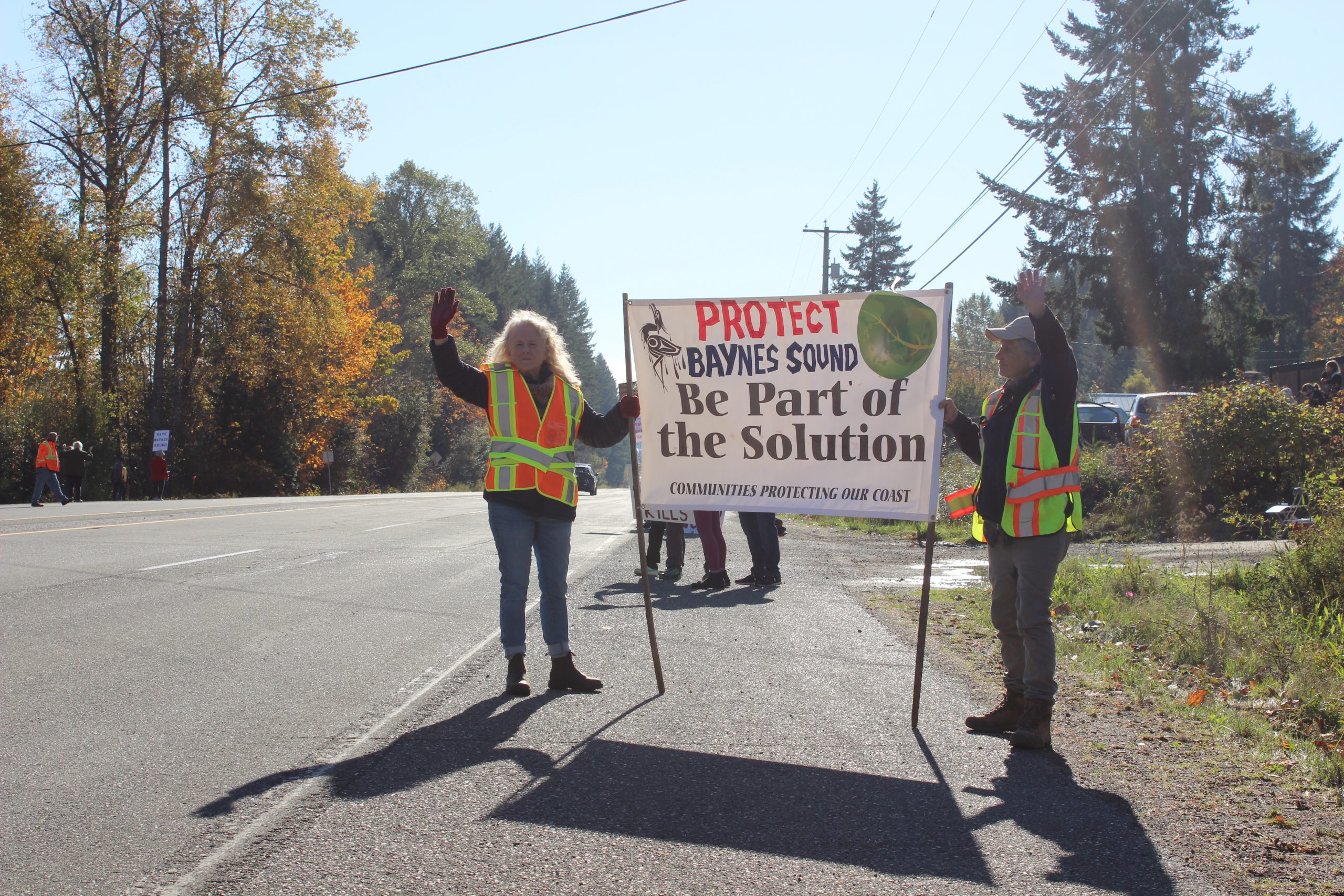
Activists rally against ship breaking operation in Union Bay
A responsibility to the entire landscape
The forum closed with comments from K’ómoks and Tla’amin representatives.
K’ómoks First Nation Councillor Candace Newman underlined that conversations such as this one are important for the Nation because they are informative and bring people together.
Newman said it’s important to get back into looking at the landscape as a whole, instead of in parts.
“Deep in our center is this holistic view of how to manage the landscape. And you can’t talk about one thing without talking about the other. And so when governments try to separate these jurisdictions and authorities, it’s really hard for us to understand because we hold a responsibility for the entire landscape from the mountainside to the bottom of the ocean.”
Connie Graham, territorial stewardship manager for the Tla’amin Nation, added that Tla’amin is working with K’ómoks to oppose Deep Water Recovery’s operations in Baynes Sound.
She said Tla’amin is fighting hard to try to get the province and the federal government into the space of “let’s all help each other.”
The Discourse has reached out to K’ómoks and Tla’amin First Nations for follow-up comment and has not yet heard back, but will continue to follow this story and opposition from community groups as it evolves.


Wow, what a mess. That little spray gun seems to be making it worse by dispersing it. I guess they want to share it wih everyone.
LikeLiked by 1 person