

Madeline is outstanding! Always objective and in-depth articles. Please consider supporting The Discourse.
“…in addition to the $46,150 fine, it is also asking Deep Water Recovery to “supply an updated financial security for the foreshore lease, in an amount of $4 million.”
The company continues to argue it is not polluting, but the province says otherwise.
BY MADELINE DUNNETT, LOCAL JOURNALISM INITIATIVE REPORTER ● COMOX VALLEY ● JANUARY 9, 2025
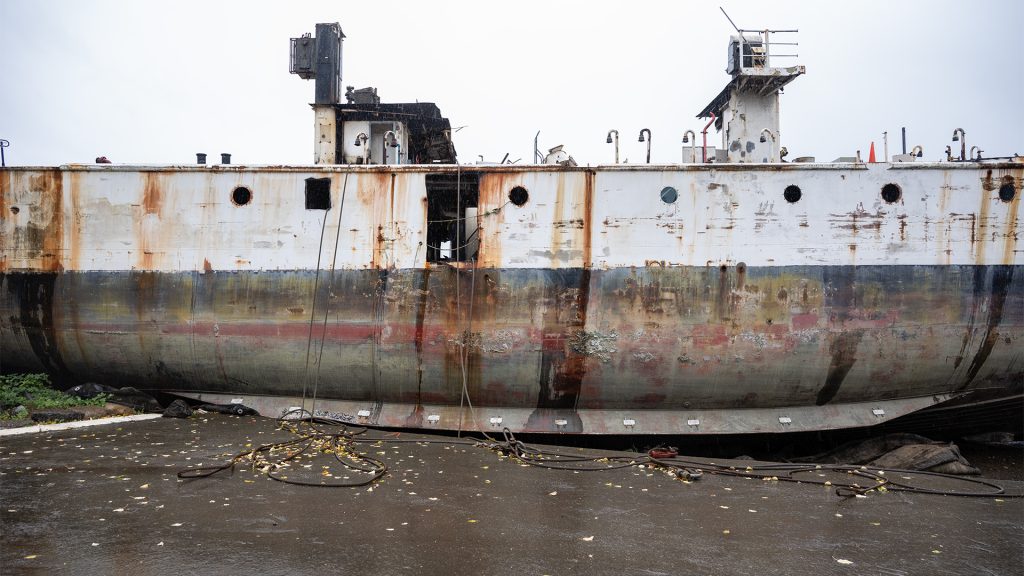
Deep Water Recovery, the company that has been dismantling ships in Union Bay since late 2020, has recently been fined $46,150 by the province for improperly disposing of waste and discharging effluent at levels exceeding water quality guidelines into Baynes Sound.
The two letters were sent to Deep Water Recovery on Dec. 12, 2024 from the enforcement branch of B.C.’s Ministry of Environment and Parks. The letters described how the fines were determined by the ministry.
The ministry issued an administrative penalty of $19,450 to Deep Water Recovery for continuing to dispose of effluent with high concentrations of copper, lead and zinc into Baynes Sound after being told to stop through a pollution abatement order. The remaining $26,700 fine was issued for allowing the waste to be introduced in the first place.
In the two letters sent to the company, Jason Bourgeois — representing the ministry’s compliance and enforcement branch — determines that because Deep Water Recovery’s facility falls within the province’s definition as a commercial waste management disposal site, all waste discharged from the facility must be authorized by the province and follow the Waste Discharge Regulation. Bourgeois says Deep Water Recovery (DWR) did not receive this authorization.
Bourgeois also notes that the recycling of large scale marine vessels is important, but that “all recyclers must also comply with applicable legislation that may be in force and ensure that all activities are performed in a manner that is protective of the environment. DWR should be no different.”
In an email to the Discourse, a spokesperson for the Ministry of Environment and Parks said that in addition to the $46,150 fine, it is also asking Deep Water Recovery to “supply an updated financial security for the foreshore lease, in an amount of $4 million.”
The term financial security is used by regulatory bodies to refer to a company having some sort of proof of credit, such as letters of credit or a surety bond — a financial agreement that is used to guarantee a party will complete its obligations. In this case, it could be used to show that Deep Water Recovery has the monetary capacity to address any damages or liabilities should it need to. The Discourse reached out to the province to clarify the details of the $4 million financial security but did not receive a response by the time of publication.
In the email statement, the province said it is taking a cross-ministry approach to “address concerns at the Deep Water Recovery (DWR) site in Union Bay and ensure the environment is protected.”
“We also ordered DWR to immediately remove a vessel which has been grounded along the shoreline and partially within the foreshore lease for over a year. DWR has demonstrated progress in preparing the vessel for hauling onto the upland,” the province said, noting that it is prepared to take further action if necessary.
Deep Water Recovery disputes ministry decision
Deep Water Recovery disagrees with the ministry decision and says its operations do not constitute commercial waste management disposal. The company asserts that its operations should not be regulated under the province’s Waste Discharge Regulation.
“DWR’s operations focus on the disassembling of marine vessels (mostly unpowered barges) for the eventual sale of the steel materials. There is no legal authority to suggest that these activities fall within the definition of commercial waste management and waste disposal,” says a statement from the company, shared in the Dec. 12 letter.
Deep Water Recovery has also filed an appeal at the Environmental Appeal Board for the pollution abatement order it received in 2024, and says it is “unduly punitive” for the ministry to issue a penalty when there is an ongoing appeal and when DWR is taking steps to comply with the order to stop polluting in Baynes Sound.
However, the ministry holds firm that starting an appeal — which is a lengthy process — does not waive the company’s obligations to stop polluting and does not pause any ministry enforcement response in the meantime.
“I do find that the director [of the Environmental Management Act] was satisfied on reasonable grounds that DWR’s activities at the facility were causing pollution, and the [pollution abatement order] was issued in response,” Bourgeois says in one of the Dec. 12 letters. “I find that a pollution abatement order under Section 83 of [the Environmental Management Act] is one of the ministry’s most powerful tools to intervene in activities where waste poses a risk to the environment, human health or public safety.”
READ ALSO

Government action could shut down shipbreaking in Union Bay, lawyer says
Tests find dangerous levels of heavy metals discharged from Deep Water Recovery facility
When a drainage area at Deep Water Recovery’s facility, called Sump 1, was tested by the province on June 26, 2024, the company was found to be discharging effluent with toxins at both acute and chronic concentrations, exceeding B.C. Water Quality Guidelines.
According to the province’s water quality guidelines, an acute level of a toxin in effluent is an amount that has been determined to cause harm to aquatic life within a short period of time. These measurements are in place to protect the most sensitive species from severe impacts — such as lethality — due to toxin exposure.
The tests found copper levels were 15,933 per cent above acute levels, and zinc was 1,249 per cent above acute levels.
The province’s water quality guidelines also have a maximum amount set before something is labelled to be chronic levels, which measure long-term impacts on aquatic life. Copper, lead and zinc all surpassed the chronic levels set out by the guidelines with copper at 23,950 per cent above, lead at 1,200 per cent above and Zinc at 7,320 per cent above chronic levels.
Company asserts pollution comes from former coal site
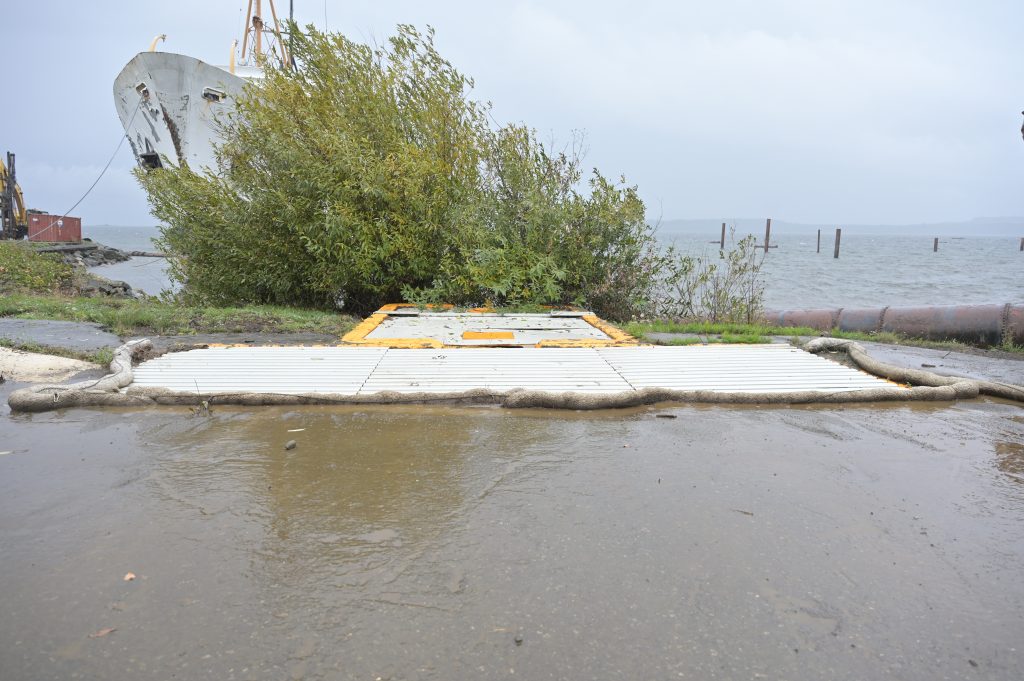
Mark Jurisich, Deep Water Recovery’s operations manager, told The Discourse that the company continues to argue it is not polluting, and that these high levels of metals are due to the area’s history of coal mining.
Union Bay used to be home to the rail line that transported coal from Cumberland to the broader market. According to the Cumberland Museum and Archives, the first rail line to Union Bay was constructed in 1889. After being sent by rail from Cumberland, the coal was then sorted, washed and stored for export on the docks, and then loaded onto ships bound for international markets, mainly the United States.
“We are not polluting. The ministry is making these accusations based on false assumptions,” Jurisich said.
He did confirm that the company is in the process of putting together a wastewater treatment plant for its facility. He also added that he thinks the company is being unfairly hammered by the province, and said there should be more consideration of the impact caused by the former coal industry in the area.
READ ALSO
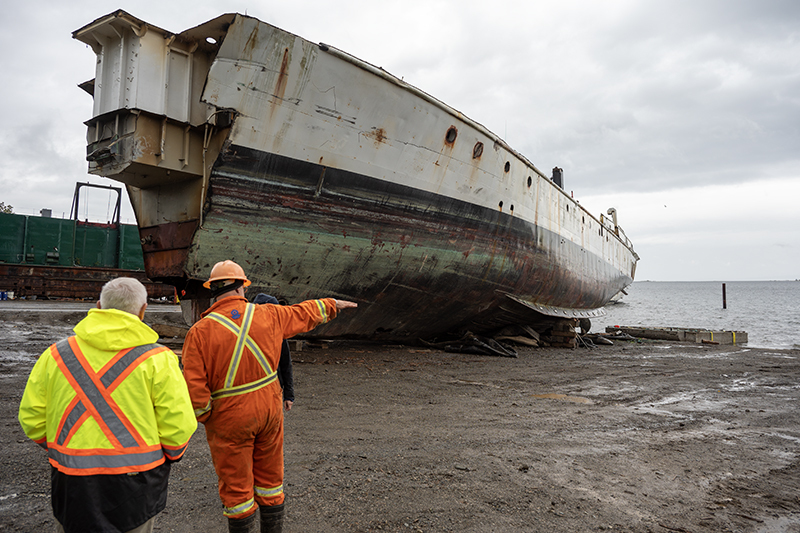
Deep Water Recovery executives say shipbreaking operations aren’t polluting Union Bay
Deep Water Recovery also doubled down on its stance in a statement shared in one of the Dec. 12 letters, saying that due to the area’s historic contamination from the coal industry, the area will test high for these metals regardless of whether DWR is operating its facility.
In a previous interview with the Discourse, Jurisich and Robert Bohn Senior — one of the company’s owners and father of Andrew Bohn, director of Deep Water Recovery — also pointed to the Union Bay Coal Pile Remediation Project. The project focuses on environmental clean-up of a neighbouring toxic site and addresses historic coal waste to mitigate environmental risks.
“We’ve got massive amounts of dissolved metals above us,” Bohn Senior said at the time.
The Discourse previously reached out to the province about whether Deep Water Recovery’s site was tested for metal contamination prior to the company beginning its operations but did not receive a clear response that provided an answer to the question. Clarification is still being sought.
Province doesn’t think company’s evidence is strong enough
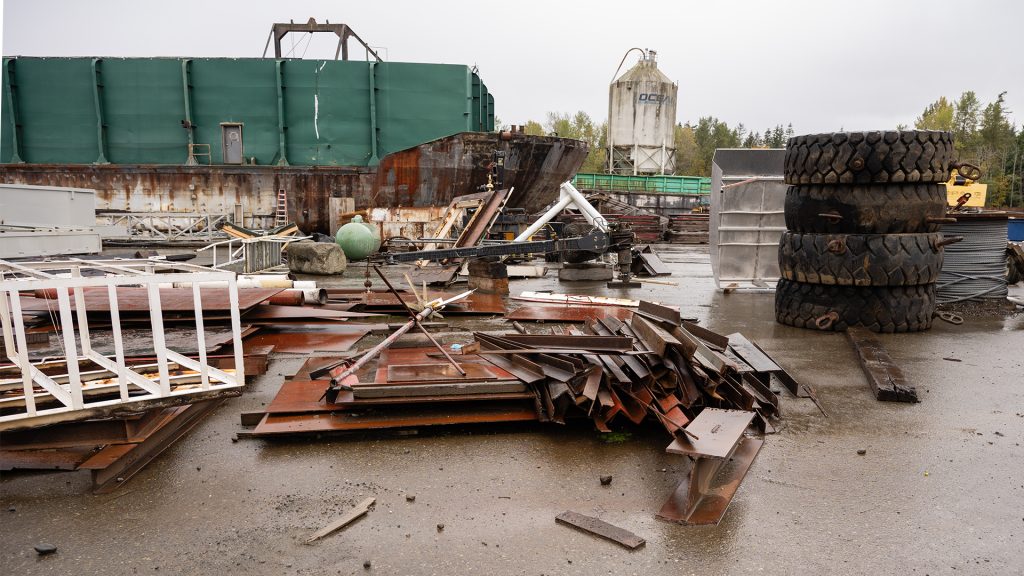
Bourgeois says in one of the Dec. 12 letters that he does not think Deep Water Recovery’s evidence of historic pollution in the area is substantial or sufficient enough to waive the penalty. He says the ministry observed effluent discharging from the sumps and gravel areas directly at the facility into the surrounding marine environment.
He adds that ministry staff observed effluent discharge surrounding the Miller Freeman — one of the vessels at the facility — underneath its hull and into the marine environment. The effluent from this sample “significantly exceeded” the province’s water quality guidelines.
“Samples collected at the facility were consistently and significantly higher than results obtained from the background sample, which confirms that onsite activities are contributing to the contamination,” Bourgeois says.
Deep Water Recovery has 30 days from the date of receiving the penalties to pay them, and 30 days to appeal if the company disagrees with the decision.
 allthingsunionbay