

https://thetyee.ca/News/2025/08/19/Controversial-BC-Shipbreaking-Company/
Its lease is cancelled. But Vancouver Island opponents are still worried about Deep Water Recovery.
Madeline Dunnett TodayThe Discourse
Madeline Dunnett reports on the Comox Valley for The Discourse, where this story was originally published. It was made possible by the Local Journalism Initiative.
Our journalism is supported by readers like you. Click here to support The Tyee.
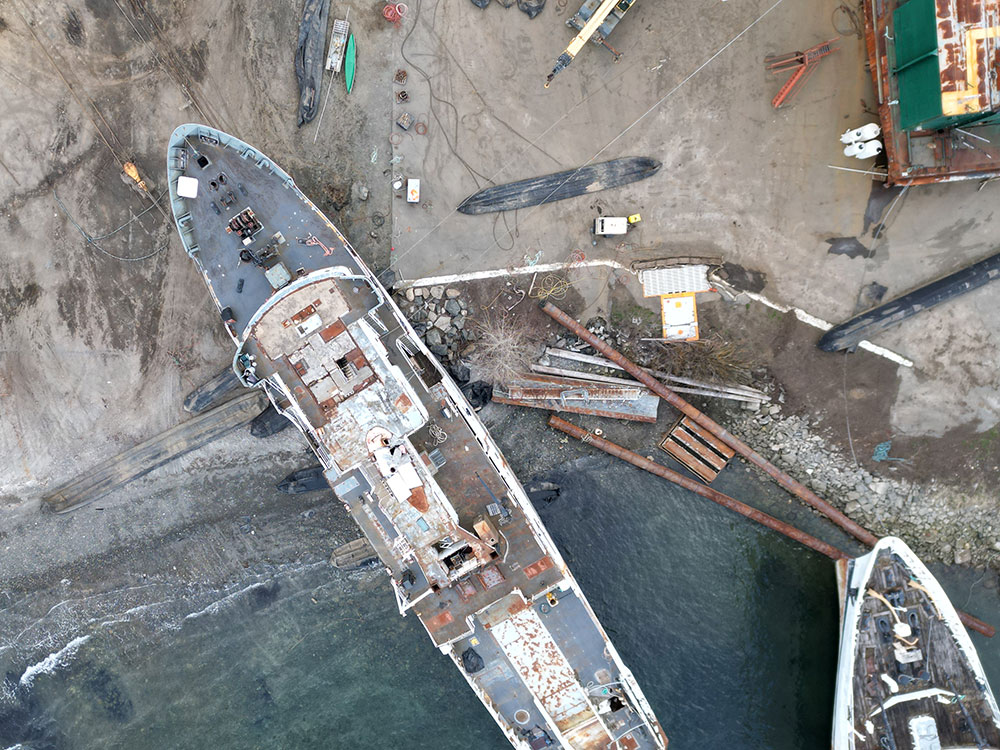
Deep Water Recovery, the company that has been dismantling ships in Union Bay since late 2020, had its Crown land lease revoked by the province last month.
Locals opposing the operation are celebrating, but they also say more work needs to be done to ensure there is adequate oversight of shipbreaking operations in Canada.
Mid Island-Pacific Rim MLA Josie Osborne’s office informed Concerned Citizens of Baynes Sound that Deep Water Recovery’s Land Act lease had been revoked because it failed to provide an updated security deposit of $3.2 million to the province and to comply with a pollution abatement order from March 15, 2024. The group has long opposed Deep Water Recovery’s shipbreaking operations in Union Bay.
The Crown land lease held by Deep Water Recovery granted it permission to operate on the foreshore in Union Bay. According to the province, “foreshore” refers to land that is between high and low watermarks of the ocean, rivers, streams and lakes.
The province ordered Deep Water Recovery to “cease all use and occupation of the Crown foreshore area and to immediately vacate the lease area,” according to the letter. It also noted that the pollution abatement order was still in effect.
Ian Munro, president of Concerned Citizens of Baynes Sound, said the lease cancellation is a critical step in the process to shut down the controversial shipbreaking operation.
But Munro shared concern about vessels that he said still remain on the site one month after the lease was revoked.
He said Concerned Citizens of Baynes Sound is waiting to have a better understanding about what will happen with those vessels and how they will be disposed of.
“We don’t have any further indication of that right now,” he said.
Deep Water Recovery did not respond to questions by the time of publication.
Years of warnings and concern
The regulatory regime governing Deep Water Recovery’s operations is complex. Generally, the federal government manages what happens offshore, including the transport of vessels to and from the site. It also has responsibilities related to the fish habitat in the tidal waters.
The province manages the company’s foreshore lease, which covers activities in the water and below the high-tide mark. But the land higher up is privately owned and governed by the land-use rules of the Comox Valley Regional District. The Indigenous land and water rights of the K’ómoks First Nation overlay all of this.
For years, residents have voiced concerns about the environmental impact of the operation on the land and water.
The company has received five administrative penalties and over a dozen out-of-compliance warnings from the province.
Deep Water Recovery appealed one of the penalties to the Environmental Appeal Board, arguing that the province’s call for monthly effluent sampling to be submitted on time was unfair due to low rainfall. On July 28, 2025, the ministry dismissed the appeal and upheld the $500 penalty. The other penalties range from $19,405 to $51,000 and, in total, the fines add up to more than $100,000.
The letter from Osborne’s office says Deep Water Recovery’s file is now in the hands of the Ministry of Forests’ Natural Resource Officer Service, which will decide next steps after the lease cancellation.
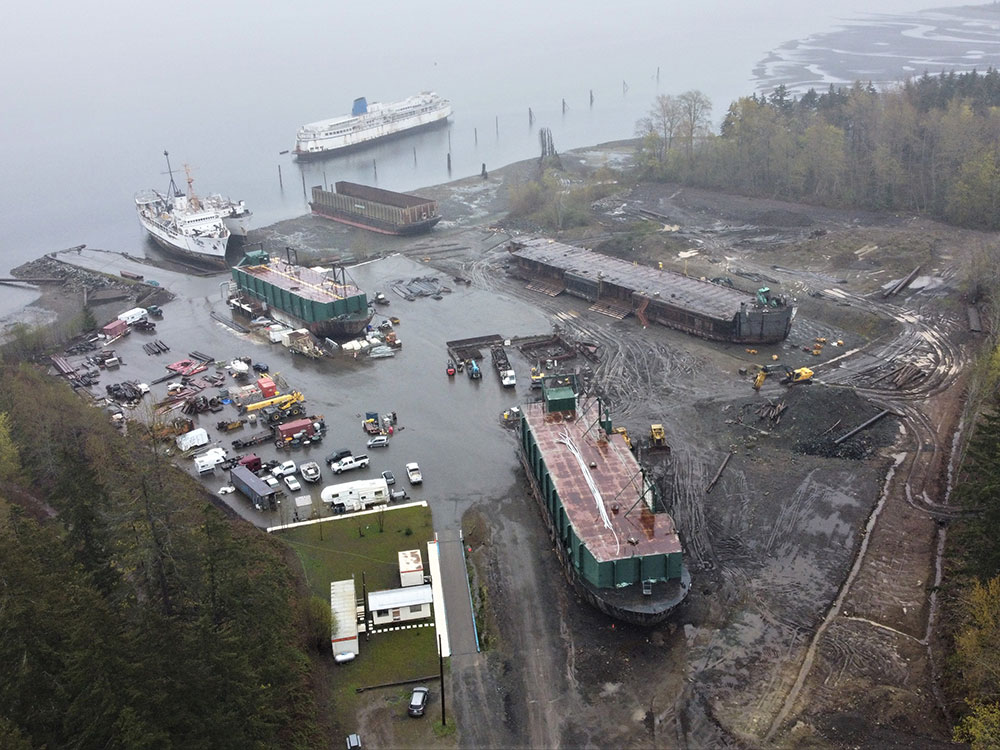
A ministry spokesperson said in an emailed statement that it will lead “administration and public engagement related to this file and will assess and address any actions required by DWR or any further contraventions of the Land Act.”
“Until this investigation is resolved, we are unable to provide any further comments,” the statement concluded.
MLA supports lease cancellation
Osborne shared her support of the lease cancellation in a Facebook post last month.
“Ship recycling, repair and maintenance are important components of B.C.’s maritime industries and they must be done safely, responsibly and in accordance with laws and regulations,” she said in the post.
Osborne pointed to concerns raised by various organizations, citizens and First Nations regarding the shipbreaking activities in Union Bay.
“Deep Water Recovery (DWR) has not demonstrated the level of regulatory compliance, operational responsibility, or environmental stewardship required to justify entrusting them with the use of Crown land to enable management and dismantling of end-of-life vessels,” Osborne’s post says, attributing this part of the statement to the province.
“Protecting people and the environment while enabling responsible industrial activity is paramount. Seeking resolutions to this local issue and the larger issue of ship recycling regulations has been — and will continue to be — a top priority for me and my MLA office staff,” Osborne said.
Concerned Citizens’ Munro also said disputes between Deep Water Recovery and the Comox Valley Regional District are ongoing.
In April 2022, Comox Valley Regional District filed a notice of civil claim in B.C. Supreme Court to stop Deep Water Recovery’s shipbreaking operations in Union Bay. The regional district said shipbreaking is not a permitted land use under the location’s current industrial marine zoning. The district asked a judge to order the company to stop shipbreaking on the site.
Deep Water Recovery issued a response the following month stating its activities fall under “boat building and repairs and service and sales, barge facility, waterfront freight handling facility [and] storage and works yard and warehousing,” which are approved uses in the zoning bylaw.
The case has not been heard in court, according to Comox Valley Regional District Electoral Area A director Daniel Arbour.
Munro also noted that both K’ómoks First Nation and Tla’amin Nation have opposed Deep Water Recovery’s operation. The company operates on both K’ómoks and Tla’amin traditional territory.
Both nations expressed their opposition to the shipbreaking operation during talks at the Baynes Sound ecological forum in November, which brought stakeholders together to discuss shipbreaking and the future of stewardship for Baynes Sound.
During the forum, Candace Newman, elected K’ómoks councillor and former K’ómoks Guardian, said she is concerned to see so much of her nation’s harvesting area lost over the years to industrial operations.
“We feel a lot of pressure from all of the industries. Today, we’re just talking about Deep Water Recovery and its impacts on our rights, but it’s hard to separate that from everything else that is happening here in the Comox Valley and on the coast of B.C.”
K’ómoks First Nation also expressed its opposition in 2021 via a press release.
A legal win for Union Bay local
Mary Reynolds — another Union Bay local who has been actively opposed to Deep Water Recovery’s operation — is celebrating a win after she was informed that she would receive more than $165,000 from Deep Water Recovery for her legal costs under the Protection of Public Participation Act.
Reynolds has been using her drone to film Deep Water Recovery’s operations in Union Bay since its early days, and she filed a civil claim in 2022 against the company.
In a statement of claim, Reynolds alleges that Deep Water Recovery operations manager Mark Jurisich and other employees of Deep Water Recovery repeatedly intimidated and harassed her. On one occasion, Jurisich snatched her drone from the air and took it. It was later returned, but it had been damaged and was inoperable, according to the court document.
Deep Water Recovery denied all of the allegations in a response filed with the court. The company launched a countersuit against Reynolds, accusing her of trespassing on its property and airspace and engaging in a “malicious campaign” against the company.
Reynolds told The Discourse that after Deep Water Recovery’s response, she “disseminated the images and recordings collected [by her drone] to third parties,” and that her lawyer, Jason Gratl, put in an application to dismiss the company’s lawsuit under the Protection of Public Participation Act.
The act protects people from strategic lawsuits against public participation, commonly known as SLAPP suits.
Reynolds told The Discourse the act is helpful for those who want to speak out about something and that it is often used to protect those speaking out on social, environmental or political issues.
A BC Ship Breaking Firm Lands in Court
Reynolds is not an official member of Concerned Citizens of Baynes Sound, but she shares the group’s concern about what will happen next.
She said she wants to know if the province can actually follow through on its decisions.
“I mean, we all applaud the decision, but you know — make it happen,” Reynolds said.
‘This should be a lesson to Canada. We need regulations’
Munro said he and the other members of Concerned Citizens of Baynes Sound are still feeling cautious about what’s going to happen next.
“Of course, we’d be concerned if activities continued,” he said. “There’s a history of activities continuing despite any government interventions.”
During a site tour last September, Robert Bohn Sr., one of Deep Water Recovery’s owners, and Jurisich told The Discourse they did not think the effluent and pollutants on the site were from their company. They argued that chemicals found in water taken from the site by the province are the product of historical coal mining operations near the site.
Who Watchdogs BC’s Ship Breakers?
Bohn and Jurisich said the company was being “unfairly hammered” and asked that community members who have been fighting against their operations leave them alone.
Munro said Concerned Citizens of Baynes Sound is ready to keep protesting the operation if it continues. Even if the shipbreaking activities stop, he said the group wants to make sure the uplands and foreshore are cleaned up and the vessels are removed.
Munro said it’s important to keep pressuring the Canadian government to create better ship dismantling standards, noting that he does not want to see similar issues happen elsewhere in the country.
Currently, there are no robust rules in Canada that are specific to shipbreaking. Instead the country relies on guidelines and other rules such as hazardous waste or contaminated sites regulation.
“This should be a lesson to Canada that we need regulations,” Munro said. ![[Tyee]](https://thetyee.ca/design-article.thetyee.ca/ui/img/yellowblob.png)
 allthingsunionbay
LABOR/LABOUR DAY ONLY x11 short days to go? OR IS IT….???
THANKS Ms D. FOR YOUR LONG TERM INVOLEMENT GETTING OUT THE TRUTH / INFO.
”If you love B.C. make D.W.R. HISTORY.”..
KEEP FLYING, KEEP TRYING, ”STOP” D.W.R.’s LYING…
***YES WE CAN*** & *** YES WE WILL*** STOP THIS INSANITY IT’S NOW UP TO US…
Facta no verba’ needed.
LikeLike