

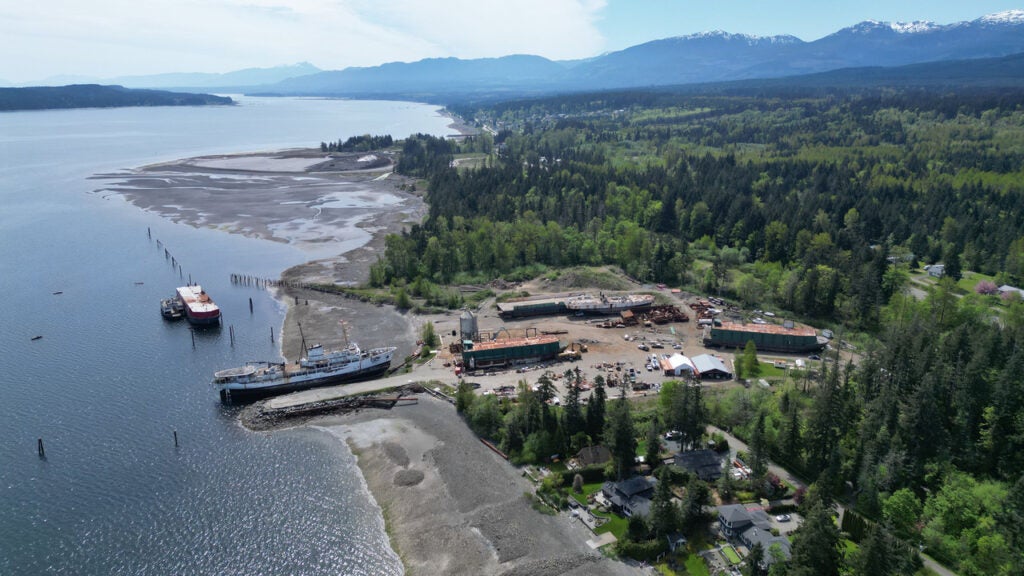
Vessels anchored at Union Bay, BC.
Maritime transportation plays a major role in moving goods and creating jobs worldwide, with over 80 per cent of global trade relying on the sector. In 2023, the maritime sector accounted for almost two per cent of the Canadian economy. But what happens when ships used for transportation and services reach the end of their lives?
The average lifespan of a ship is 20 to 30 years. When ships are retired from service, they are sent to be scrapped and their parts to be recycled, a process called “shipbreaking.” To be efficient, the recycling process should embrace the “cradle to grave” concept. That means that almost all materials and equipment used in the manufacturing process are reused in other forms, producing an environmentally friendly and energy-efficient outcome. Although this should be good news in the circular economy context, Canada does not have specific regulations for shipbreaking, which means ships can be dismantled without addressing human safety concerns and environmental risks.
End-of-life ships can contain various amounts of toxic materials in their structure, and those need to be properly identified and disposed of during the scrapping process. When shipbreaking occurs in coastal areas — a process called “beaching” — instead of proper, enclosed facilities, the toxic waste contaminates the environment and exposes workers to hazardous substances. In fact, some of these toxic materials are well known: asbestos, PCBs and heavy metals such as lead, mercury, copper, cadmium and zinc. All these contaminants can be found in the ship’s paints, coating, insulation, batteries and electrical components.
In 2025, the Canadian government released an update on the significant demand for ship recycling regulations across the country, particularly on the West Coast, where nearly 900 vessels currently wait to be recycled. In the Howe Sound bioregion, for example, the negative impacts of derelict vessels on small beaches of Gambier Island and the Sunshine Coast have already been observed. Without proper destinations, these ships either break free or sink, threatening marine ecosystems.
Since 2020, Union Bay, north of Nanaimo on Vancouver Island, has been used as a facility for shipbreaking. Ironically, the small bay is classified as an “ecologically and biologically significant area” because of its proximity to Baynes Sound, which is a particularly important staging area for thousands of migratory birds during the spring herring spawn. The region also comprises half of B.C.’s commercial shellfish production.
The Union Bay site is owned by Union Bay Industries, which previously used it to sort logs. During recent years, several vessels have been brought for dismantling. Such activities have raised concerns from local communities and First Nations about site contamination from effluent runoff in the marine environment and lack of proper waste management.
Although Canada does have some regulations shared across different levels of government that manage shipping — Transport Canada is responsible for activities at sea, for example — none specifically target shipbreaking. Cases like Union Bay highlight the regulatory gaps that arise from the lack of a coordinated cross-governmental approach. The current patchwork regulations burden small communities with managing shipbreaking pollution in their backyards even though they have limited power to prevent or control the activities.
International frameworks such as the Hong Kong International Convention for the Safe and Environmentally Sound Recycling of Ships, which came into force in June of 2025, aim to target both ship construction and dismantling phases to guarantee ships are designed and built for safe recycling without impact on performance. Even though the convention has been strongly criticized for not banning beaching practices for example, it is a first step towards addressing shipbreaking activities in domestic waters.
Canada took part in the development of the convention, although it has not ratified it. It is time to do it now.

