
EDIT: Heard from a couple of people that had the impression BLG won the PPPA application – they didn’t. Most of their countersuit was thrown out so they are hobbled in what remains. Also, notice they don’t mention costs? Lawyers get dinged pretty hard when their actions are intended as a SLAPP suit and BLG was dinged pretty damn hard, this all before the trial – the whole point of the Protection of Public Participation was to stop those SLAPP suits. The initial lawsuit is scheduled for trial in October 2025 in Vancouver and already BLG has racked up one legal loss after the other in the last 2 1/2 years retreating and scurrying away from their bizarre pleadings.
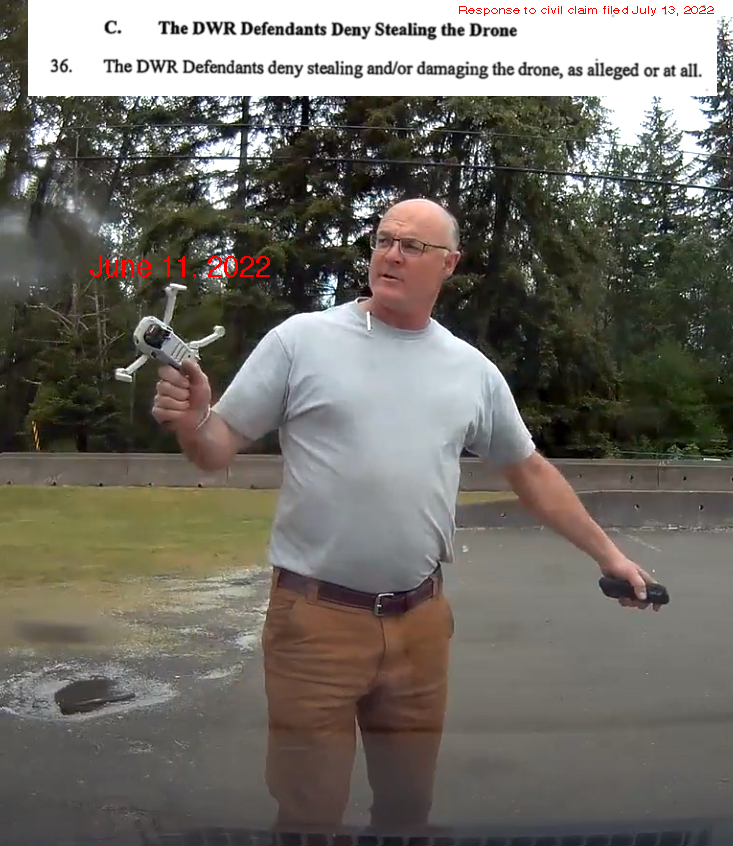
The lawsuit was initiated because thug/robber Mark Jurisich robbed me of my property (drone) at the Union Bay Community Hall June 11/22. BLF filed a countersuit July 13/22 full of bullshit and they were the ones who repeatedly stated I was disseminating the images. Maybe they shouldn’t have been so careless with the words they used in their legal submissions since Justice Morley April 8/24 stated on page 38 of his decision (document is in the post DWR loses lions share of lawsuit) :
She has a constitutional right to publicly oppose DWR’s operations and contribute to the debate on whether they should continue, on her own or in conjunction with others. Characterizing this as a “campaign” is fair enough. Characterizing it as “malicious”, “wrongful”, “high-handed” and “deserving of rebuke” is not just over-the-top-rhetoric, but troubling in itself in a pleading. Ms. Reynolds no doubt would like to see DWR’s operations shut down, but that is her right.
They claimed I physically trespassed on DWR numerous times when I have not set foot on their property. During the PPPA DWR had to concede the road across from DWR has a statutory Right of Way on it and the public are allowed – even me. They claimed thug/robber Jurisich didn’t steal my drone but if he did then it was because I provoked him. Like the abusive spouse – he/she provoked me.
February 05, 2025
ARTICLE
Diving deeper into the PPPA: Reynolds v Deep Water Recovery Ltd.
The Protection of Public Participation Act, S.B.C. 2019, c. 3 (the PPPA) creates a pre-trial procedure that allows a defendant to apply to the court for an order dismissing a proceeding that arises out of an expression on matters of public interest. But what happens when the proceeding deals with matters that not only involve expression on a matter of public interest but also separate, non-expressive acts and causes of action?
This issue arose in Reynolds v. Deep Water Recovery Ltd., 2024 BCSC 570, when the court considered whether information gathering could be expressive activity because it could lead to expression and whether purely physical causes of action can “arise out of” expression, and therefore garner protection under the PPPA.
What you need to know about the PPPA
- The purpose of the PPPA is to protect expression on matters of public interest from being excessively chilled by the threat of litigation arising out of that expression.
- A dismissal application under the PPPA first requires the applicant to meet a threshold burden. They must prove that the proceeding arises from expression that relates to a matter of public interest.
- The term “expression” is defined in the PPPA as “any communication, whether it is made verbally or non-verbally, publicly or privately, and whether it is directed or not directed at a person or entity”.
- The definition of “proceeding” is flexible, and it is within the discretion of the chambers judge hearing a dismissal application to analyze discrete facts, legal theories and remedies, and “prune” a pleading, thereby allowing some claims to go to trial, while dismissing others.
Background
In September 2021, Mary Reynolds began flying a drone to record videos of marine vessel services being performed by Deep Water Recovery Ltd. (DWR) in Union Bay on Vancouver Island. She flew her drone on, over or around DWR’s property. She says that she did so because she was concerned with alleged environmental harms occasioned by DWR’s operations and wanted to contribute to public debate. Towards that purported end, she disseminated her videos.
On June 20, 2022, Ms. Reynolds filed a Notice of Civil Claim against DWR, one of its principals, and four unknown employees, alleging causes of action in conversion/trespass to goods, harassment, assault, and intimidation. Among other things, she alleged that one of DWR’s employees took her drone without her consent, and later returned it with its memory card tampered with.
DWR denied all the allegations and filed a counterclaim against Ms. Reynolds. DWR’s Counterclaim alleged that Ms. Reynolds’ activities gave rise to claims of trespass, nuisance, and invasion of privacy.
In turn, Ms. Reynolds applied to have the counterclaim dismissed under s. 4 of the PPPA. She argued that the PPPA applied to her actions because she filmed DWR’s marine vessel services to contribute to a public debate about the alleged environmental harms occasioned by DWR’s operations. Ms. Reynolds argued that the term “expression” under the PPPA should be broadly interpreted as including information gathering. She contended that, without the physical act of flying her drone over DWR’s facility, she would not have been able to effectively engage in expression on matters of public interest. She argued that her means of obtaining the footage was expressive, as was her dissemination of the videos.
DWR argued that information gathering was not expressive under the PPPA and that the PPPA did not apply. DWR supported its argument by reference to an analogy; if Ms. Reynolds’ broad interpretation of expression was accepted, the PPPA could be used in defence of a person breaking into a commercial building or home and rifling through a filing cabinet, if the ultimate purpose is to bring to light a secret of public interest.
The decision of the court
The court divided the counterclaim into three parts, with each part being treated as a “proceeding” that represented distinct facts, distinct harms, and distinct remedies and legal theories.
- The physical activity of flying the drone was identified as the basis of a claim in trespass and possibly nuisance, giving rise to a request for a declaration, an injunction against further drone flying, and compensatory damages for any losses suffered prior to trial as a result of the flying. The chambers judge referred to these as the “Physical Intrusion Claims.”
- The surveillance of DWR’s workers and operations was identified as the basis of a claim under the Privacy Act and possibly nuisance because the surveillance interfered with the reasonable use of DWR’s property, giving rise to a claim for general damages. The chambers judge referred to these as the “Surveillance Claims.”
- The dissemination of the images obtained through surveillance was also identified as the basis of a claim under the Privacy Act, giving rise to a claim for punitive damages. The chambers judge referred to these as the “Dissemination Claims.”
Focusing first on the Physical Intrusion Claims and Ms. Reynolds’ argument that information gathering should be “expression”, the court grounded its analysis in the purpose of the legislation and the specific language used by the Legislature. The court determined that the PPPA created protection from private litigation and that it was up to the Legislature to explicitly define the scope of that protection in the words of the statute. The court also determined that when an enactment restricts common law rights, the enactment is presumed not to do so more than can be found in the explicit meaning of the statute or its necessary implications.
According to the court, the most important reason to reject Ms. Reynolds’ interpretation of the term expression is because it “goes against the operative background presumptions when an enactment restricts common law rights.” Indeed, her interpretation would go “well beyond the explicit or necessarily implied restrictions on common law rights of action” in the legislation. The Legislature circumscribed the application of the PPPA to communications, not information gathering that could lead to communications. That being the case, the court held that the threshold burden on a dismissal application “cannot be met by showing that the proceeding arises from activity that was useful, or even necessary, for the applicant’s expression.” A similar conclusion was reached with respect to the Surveillance Claims.
Despite this, the court went on to consider whether the Physical Intrusion Claims and the Surveillance Claims arose from an expression. This was necessary because even purely physical causes of action that do not involve expressive elements can still “arise out of” expression if the proceedings were motivated by the expression.
While it was not necessary for Ms. Reynolds to demonstrate that silencing or retaliating against her expression was the predominant motivation of the proceeding, it was not sufficient to show a “mere taint” of mixed motivation. Something more was required.
To meet her threshold burden, the court determined that Ms. Reynolds had to establish, on a balance of probabilities (meaning more likely than not), that the Physical Intrusion Claims and the Surveillance Claims would not have been initiated if her dissemination of videos had not occurred. This is what is commonly known as a “but for” causation analysis.
There was an obvious competing explanation for the Physical Intrusion Claims and the Surveillance Claims, namely that they were raised to define what Ms. Reynolds can and cannot do with her drone. The court noted that the law of what people can legally to do with their drones in the vicinity of other people’s property is “undeveloped” and that the Counterclaim raised reasonable issues in that regard. That all being the case, the threshold burden could not be met in respect of the Physical Intrusion Claims and the Surveillance Claims.
Nevertheless, the court found that certain aspects of the Counterclaim did involve expression on matters of public interest. Those aspects of the Counterclaim were raised in the Dissemination Claims. The court held that it was appropriate to prune away those elements of Counterclaim, noting in part that they manifestly arose from expression.
Key takeaways
- The Supreme Court of British Columbia’s decision in Reynolds v. Deep Water Recovery Ltd. clarified the scope of the PPPA’s protection.
- Distinct facts, distinct harms, and distinct remedies and legal theories can, and in some instances should, be analyzed on their own. “Pruning” a pleading is permitted.
- When an enactment such as the PPPA restricts common law rights, the enactment is presumed not to do so more than can be found in the explicit meaning of the statute or its necessary implications. Courts must take care to not to overreach and go beyond the purpose and express language of the PPPA.
- Expression that relates to a matter of public interest is the sine qua non for protection under the PPPA.
- Information gathering is not expression under the PPPA but causes of action that do not involve expressive elements can still “arise out of” expression if the proceedings were motivated by the expression.
- The test for determining whether proceedings arise from an expression does not necessarily require the applicant to demonstrate that silencing or retaliating against their expression was the predominant motivation of the proceedings.
- It is not sufficient to show a “mere taint” of mixed motivation. Something more is required. The applicant must establish, on a balance of probabilities, that the proceedings would not have been initiated if the expression had not occurred.
BLG has acted for plaintiffs and defendants involved in several PPPA applications. In the instant case, BLG acted for Deep Water Recovery Ltd. For more information, please reach out to any of the key contacts listed below.
- Services: Disputes, Defamation & Media Law
 allthingsunionbay